Glue sheets or bait? How rodent control works in a food plant
Why rodent boxes inside a food site usually hold glue sheets, where poison bait belongs, and how the two work together to keep rats and mice out.
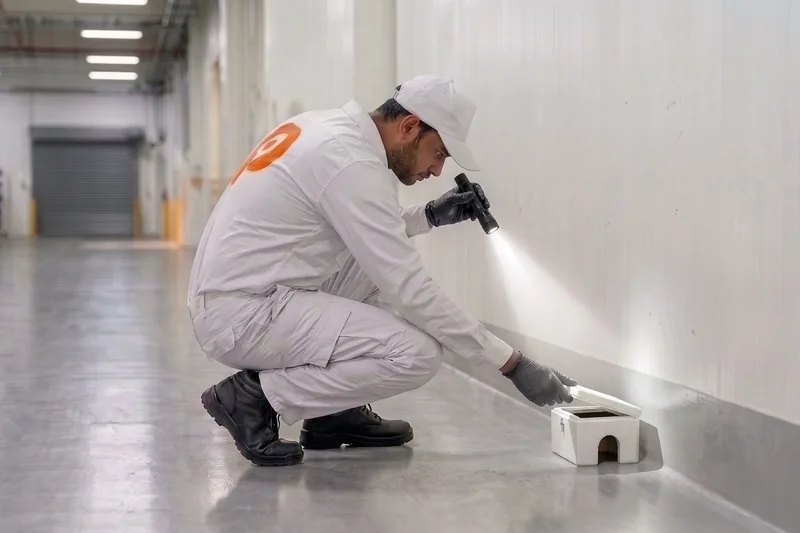
Walk around any well-run food plant and you will see rodent boxes along the walls, inside and out. They look the same, but what is inside them is often not. The difference is deliberate, and it is one of the first things an auditor checks.
Two jobs, two tools
Rodent control in a food site has two separate jobs:
- Stop rats and mice getting in, on the perimeter, fences and outer walls.
- Catch and detect any that do get in, inside the building.
Each job needs a different tool.
Outside: bait on the perimeter
On the boundary wall and around the outside of buildings, lockable bait stations hold rodenticide bait. A rat that eats it dies away from the station, usually back in its burrow, so the population living around the site is reduced before it ever reaches the doors.
The stations are locked and fixed in place so that the bait cannot be carried off, children and animals cannot reach it, and rain does not spoil it.
Inside: glue sheets and traps
Inside a building where food is made, stored or packed, poison bait is the wrong tool. A poisoned rodent can die somewhere you cannot reach, behind a machine or in a ceiling void, and become a contamination problem of its own. Bait that is moved or spilled near food is a risk in itself.
So inside, rodent boxes hold glue sheets or mechanical traps instead. They catch the animal in the box, where it can be found and removed, and they show exactly where and when a rodent was active. That evidence is what tells you where it is getting in.
A catch inside is not a failure. It is information: which door, which drain, which gap needs fixing.
Checking the boxes is the real work
A rodent box only works if it is checked. Between visits, a glue sheet can fill with dust, get wet, or be knocked out of place, and then it catches nothing. That is why each box should be opened at every visit, the sheet checked or changed, and what was found written against that box’s number.
At Pointerz every box carries a QR code, and the technician’s app opens a station only by scanning it, so each box has its own record for every visit. A box that was skipped shows up instead of hiding in a tick-box.
What the records tell you
Over a few months, the catches build into a map. If most activity is near the dispatch doors, the doors need better seals or need to be kept shut. If it is around one drain, the drain needs a cover. Treatment handles the rodents you have; proofing the building stops the next ones.
That is why our reports put findings by location, with photos, rather than as a single number for the whole site.